Dark Matter: Still Missing, But Harder to Hide
May 6, 2026News
Most of the universe is made of something we have never seen.
Galaxies rotate too quickly, clusters hold together too tightly, and large-scale structures form in ways that visible matter alone cannot explain. The conclusion is unavoidable: there is more out there than meets the eye. This unseen component, called dark matter, outweighs ordinary matter by a wide margin, yet it has never been directly detected.
A recent paper in the Journal of Cosmology and Astroparticle Physics brings that hunt a meaningful step forward, not by finding dark matter, but by ruling out another place it could be hiding.
At the center of the study is the axion, a hypothetical particle proposed in the late twentieth century to resolve a subtle inconsistency in particle physics known as the strong CP problem. What began as a theoretical patch soon developed into something much more ambitious. Under the right conditions, axions could make up the entirety of dark matter in the universe.
If that is true, they would be everywhere, streaming through space and through us, almost entirely undetected. Their defining feature is not just their small mass, but their extreme reluctance to interact with ordinary matter. That makes them a compelling candidate. It also makes them extraordinarily difficult to find.
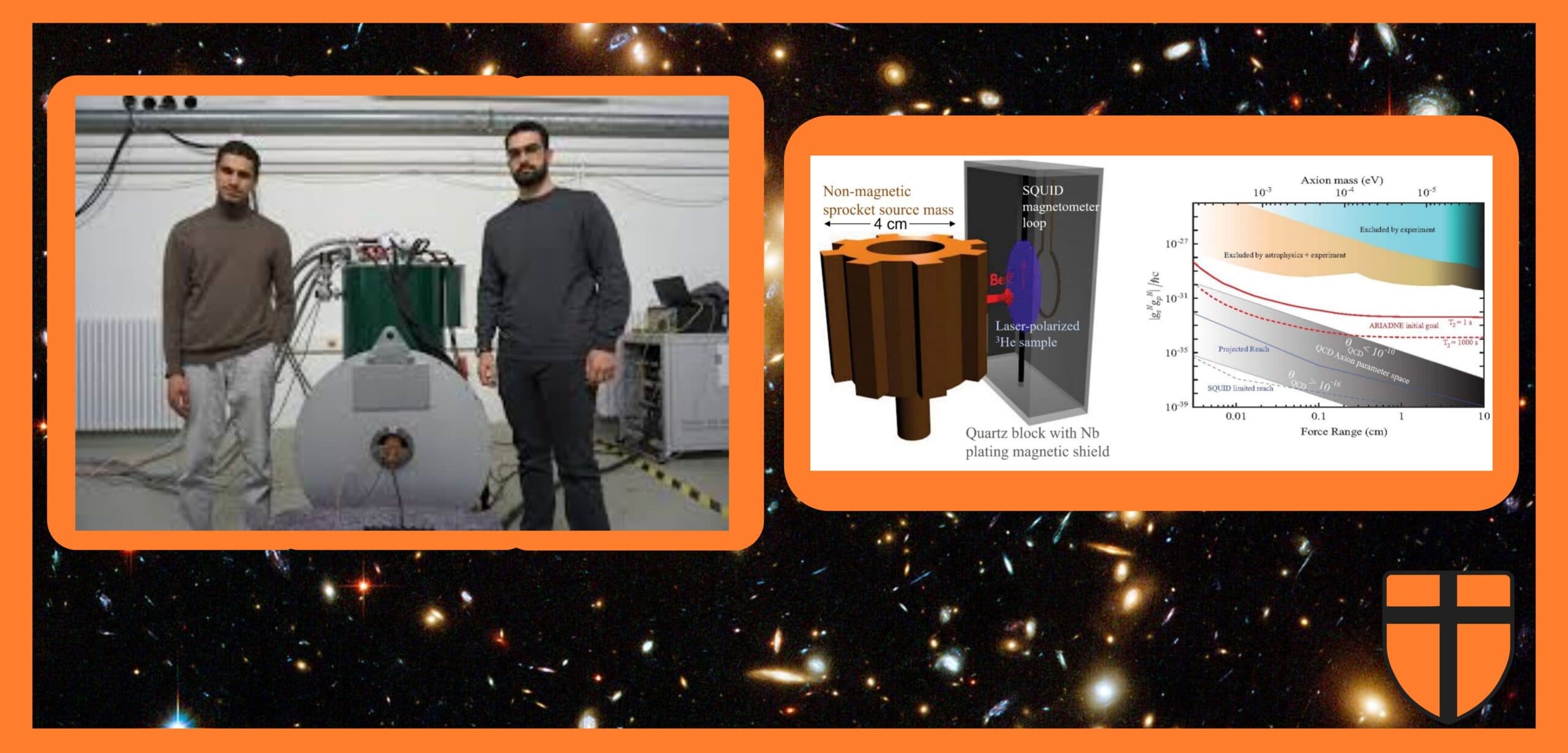
The experiment described in the paper, known as the Student Project for an Axion Cavity Experiment, or SPACE, attempts to detect axions indirectly by converting them into something we can measure. The method relies on a prediction from electromagnetic theory. In the presence of a strong magnetic field, axions should occasionally convert into photons, producing a faint electromagnetic signal at a frequency corresponding to the axion’s mass.
The setup is elegant in concept and magnificent in execution. A precisely machined copper cavity is placed inside a powerful superconducting magnet running at fourteen tesla. The cavity is tuned to resonate at a specific frequency, in this case around four gigahertz. If axions with the corresponding mass pass through the apparatus, they should generate a tiny excess of power inside the cavity, a whisper of energy that would betray their presence.
“Tiny” is an understatement. The expected signal is on the order of 10⁻²⁰ watts, far below everyday levels of electrical noise. Detecting it requires extreme sensitivity, careful calibration, and relentless attention to detail. Every source of interference, from thermal fluctuations to drifts in the cavity’s resonance frequency, has to be tracked, modeled, and corrected.
Over a span of about seventy-one hours, the experiment recorded nearly two billion individual measurements. Each spectrum was processed, filtered, and combined using statistical techniques designed to reveal even the faintest signal. The data were continuously monitored to track small drifts in temperature, resonance frequency, and system noise. Nothing obvious could be trusted. Everything had to be measured, modeled, and corrected.
In the end, no convincing signal appeared. That absence carries weight. The experiment sets a new upper limit on how strongly axions, if they exist in this mass range, can interact with photons. The improvement is not marginal; it surpasses previous constraints by more than two orders of magnitude. A region of theoretical possibility that once seemed viable is now effectively closed.
This is how much of modern physics advances. Discovery is rare and dramatic, but constraint is steady and cumulative. Each null result trims away a portion of the unknown, forcing theories into tighter alignment with reality. In this case, the SPACE experiment significantly reduces the parameter space where axions of this particular mass could be hiding. The range from 16.626 to 16.653 microelectronvolts is now far better mapped than it was before.
The implications extend forward. Future searches will not start from scratch. They will build on these limits, pushing into new frequency ranges or improving sensitivity within known ones. The current experiment still falls short of probing some of the most well-motivated theoretical models, sitting within a factor of forty-four of the KSVZ benchmark, one of the canonical predictions for how strongly axions should couple to photons. But the gap is narrowing. Advances in low-noise amplification, quantum measurement techniques, and longer observation times are steadily moving the field closer to that threshold.
There is also a broader shift underway. Dark matter research has matured from speculative theory into a structured experimental program. Instead of asking loosely whether a candidate might exist, physicists are now mapping the possibilities with increasing precision. The landscape is not shrinking so much as it is sharpening. The regions that remain are the ones that matter most.
Notably, the SPACE experiment was built and operated by students at the University of Hamburg, a first for Germany in this class of axion search. That a student-led effort could produce results surpassing decades-old constraints speaks to how far the field’s tools and methods have come, and how distributed the search for dark matter is becoming.
For the moment, dark matter remains invisible. The axion, if it exists, continues to evade detection. But it is no longer unconstrained. With each experiment, the space in which it can exist becomes smaller and more sharply defined. That narrowing is not a failure. It is the slow, necessary architecture of discovery, the work of ruling things out until only the truth remains.