Gran Sasso Science Institute and the NUSES Mission: Terzina’s First Look at Ultra-High-Energy Showers from Space
Feb 23, 2026News
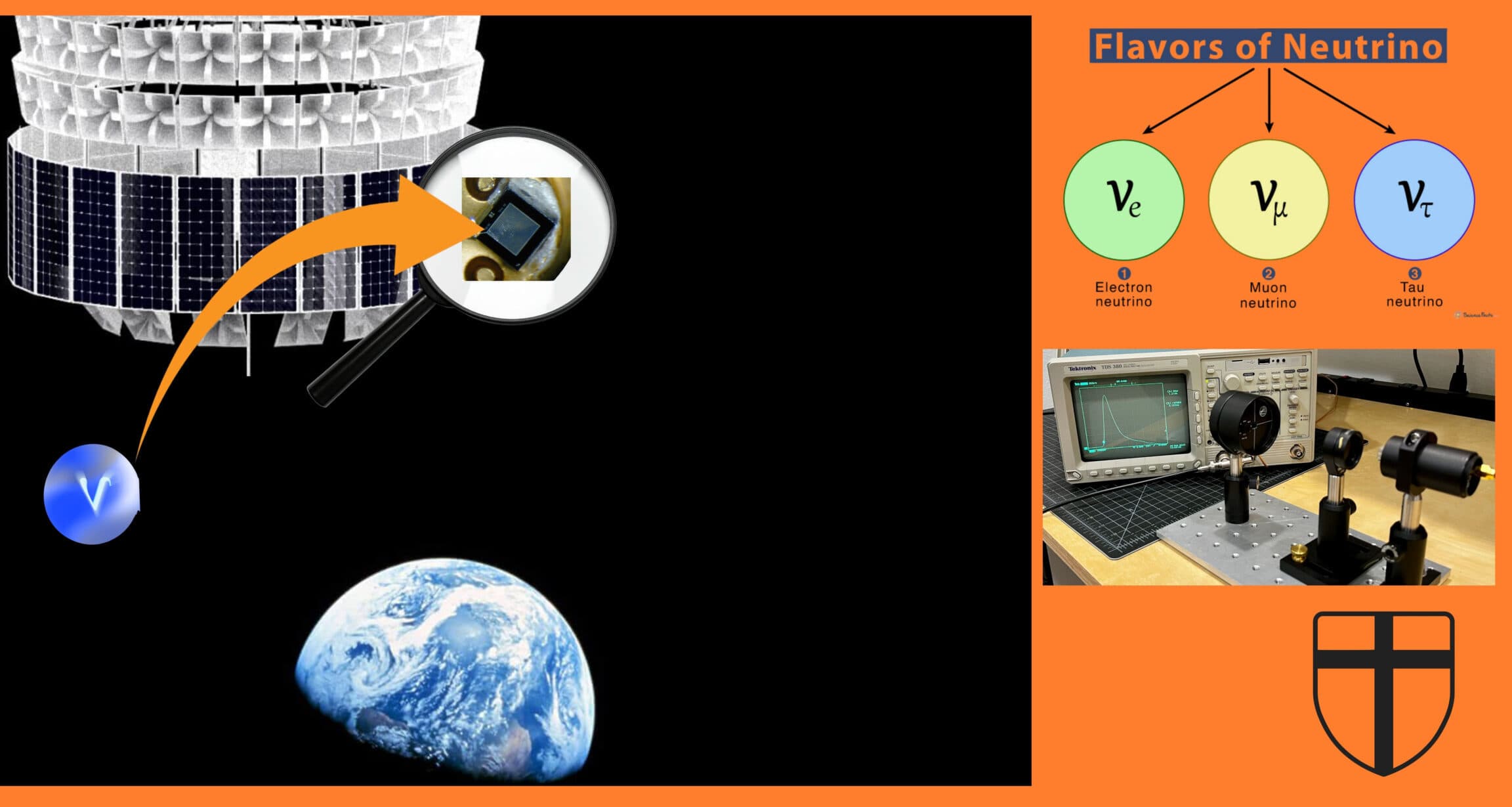
In September 2025, at the 39th International Cosmic Ray Conference in Geneva, Teresa Montaruli and the NUSES Collaboration presented a compact space telescope designed to test whether man can routinely detect ultra-high-energy cosmic rays (UHECR) and even astrophysical neutrinos from orbit.
The instrument is called Terzina. It flies aboard NUSES, a low Earth orbit satellite currently expected to launch in 2027. It aims to demonstrate the feasibility of detecting atmospheric Cherenkov light, a distinct blue glow produced when charged particles travel through a medium faster than light can in that same medium, and to validate this technique for future missions.
The UHECR and the neutrinos Terzina seeks to detect are extremely rare. Ground-based experiments, such as IceCube, detect only a handful of events per year at these energies. To improve statistics, exposure must increase, and few approaches observe as much target mass as Terzina will.
Instead of utilizing a cubic kilometer of ice, as IceCube does, Terzina uses the atmosphere itself as a radiator. When a cosmic ray or a tau neutrino emerging from the Earth’s crust initiates an air shower near the limb, or edge, of the Earth, the charged particles emit nanosecond flashes of blue Cherenkov light. From a roughly 550 km altitude, Terzina stares at that limb and waits.
The geometric advantage is substantial. From orbit, the visible atmospheric target mass is enormous. In limb-viewing configurations, showers can occur thousands of kilometers from the detector, yet the vast observational footprint compensates for the distance.
Operating in orbit, however, presents serious challenges for silicon sensors. Radiation from the sun and trapped protons and electrons raises the rate of random thermal pulses which can mimic a signal. The collaboration designed custom SiPM tiles for the satellite to detect photons. Terzina therefore serves as both a physics instrument and a technology trial, testing how SiPMs behave in near-unshielded space conditions.
UHECR detection rates can vary dramatically. Lunar interference periodically interrupts observations when the Moon enters the field of view, and background light can obscure cosmic rays. Nevertheless, simulations suggest that even against a 200 kHz background, Terzina should detect on the order of 88 UHECR events per year.
Neutrinos remain far more challenging. Their expected rate is roughly four orders of magnitude smaller than that of UHECRs. A single satellite is unlikely to secure a detection, but it can establish improved upper limits and validate the detection concept for future satellite constellations.
Simulations show that most Cherenkov photons originate at altitudes of roughly 25 to 30 km. The Cherenkov cone at those heights spans about 10 km in radius, yet Terzina captures only a fraction of that cone due to distance. Reconstructing the full shower geometry would require multiple satellites; a fleet of them could triangulate the Cherenkov cone and recover composition information across the transition from galactic to extragalactic cosmic rays, one of the least understood regions of the spectrum.
NUSES is funded by the Italian government and built through a collaboration among GSSI, INFN, the University of Geneva, and industrial partners. It is a sort of trial run mission, to find a way forward for future experiments. Larger concepts such as POEMMA envision multi-satellite systems targeting different parts of the cosmic ray spectrum.
Terzina’s goals are twofold: to demonstrate that Cherenkov detection of UHECRs from space is technically viable, and to characterize technology performance in different conditions. If successful, it will establish a blueprint for cost-effective satellite constellations capable of monitoring thousands of square kilometers of atmosphere continuously. A small Italian-led satellite will watch the edge of the Earth for flashes of blue light lasting only billionths of a second, signatures of particles more energetic than anything human technology can produce. From those flashes, we may learn where the universe’s most powerful accelerators reside and open a new window on extreme astrophysical phenomena.