Artemis II: Humanity’s Return to the Moon and the Wonder of Creation
Jan 23, 2026News
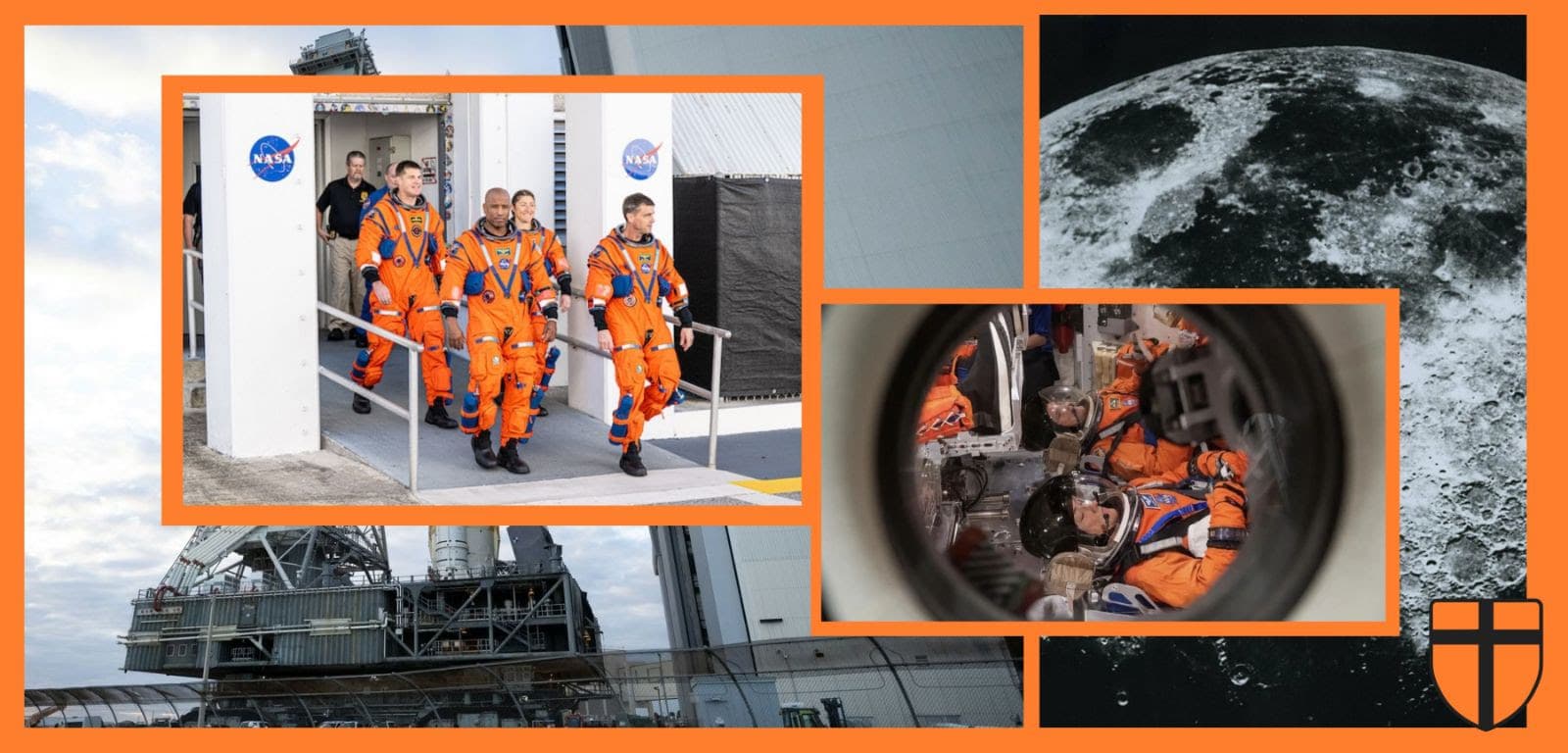
For the first time in more than half a century, human beings are preparing to journey once again into lunar space. NASA’s Artemis II mission, currently scheduled to launch February 2026, will send four astronauts on a crewed flight around the Moon, marking humanity’s first return to the Moon’s vicinity since Apollo 17 concluded the Apollo era in December 1972. It is a moment of both technological significance and deep human meaning, inviting reflection on human ingenuity, cooperation, and our place within the vastness of creation.
Artemis II represents the opening crewed chapter of NASA’s Artemis program, which aims to establish a sustained human presence on and around the Moon as a stepping stone toward future exploration of Mars. Unlike the uncrewed Artemis I test flight in 2022, Artemis II will carry astronauts aboard NASA’s Orion spacecraft, testing life-support systems, navigation, communications, and crew operations far beyond low Earth orbit.
The mission itself will last approximately ten days. Following launch aboard NASA’s Space Launch System, the most powerful rocket ever flown, the crew will spend time in high Earth orbit conducting critical system checkouts. These early phases allow the astronauts to test Orion’s life-support, propulsion, and navigation systems while still relatively close to home, ensuring the spacecraft is fully ready for deep-space flight.
Once these tests are complete, Orion will perform a translunar injection burn, sending the spacecraft on a carefully designed free-return trajectory around the Moon. This path uses the combined gravitational forces of the Earth and Moon to carry the spacecraft around the lunar far side and back toward Earth, providing a built-in safety margin should major systems fail. As the crew passes beyond the Moon’s far side, they will travel farther from Earth than any humans have ever gone, briefly disappearing from radio contact as the Moon blocks direct communication.
During the lunar flyby, the astronauts will observe and photograph the Moon’s surface, gaining firsthand experience of the environment future crews will explore in greater depth. Artemis II will not enter lunar orbit or land, but its observations and operational data will directly inform Artemis III, the mission planned to attempt the first human landing near the Moon’s south pole later in the decade. That region is of particular scientific interest due to the presence of permanently shadowed craters that may contain water ice, a critical resource for long-term exploration.
Orion’s journey would not be possible without its European-built service module, developed by Airbus for the European Space Agency. This module provides propulsion, electrical power, thermal control, and consumables such as oxygen and water, enabling Orion to function as a true deep-space spacecraft. The Artemis program as a whole reflects an unprecedented level of international cooperation, with contributions from Canada, Europe, and many other partners committed to the peaceful exploration of space.
The return to Earth will be among the most demanding phases of the mission. As Orion reenters Earth’s atmosphere, it will experience extreme temperatures and stresses, approaching speeds comparable to those endured by Apollo crews returning from the Moon. The spacecraft’s heat shield, already tested during Artemis I, will protect the crew as Orion descends for a planned splashdown in the Pacific Ocean, where recovery teams will be waiting.
Beyond its technical objectives, Artemis II carries a powerful symbolic dimension. Space exploration has long served as a mirror for humanity’s deepest questions about origin, purpose, and destiny. When the Apollo 8 astronauts orbited the Moon on Christmas Eve in 1968 and read from the Book of Genesis, they offered the world a moment of shared reflection as Earth rose over the lunar horizon. Artemis II stands in continuity with that legacy, reminding us that scientific achievement and spiritual wonder need not stand in opposition.
The Moon itself remains a scientific treasure. Formed more than four billion years ago, it preserves a record of the early solar system largely erased on Earth by erosion and plate tectonics. Samples returned during the Apollo missions revolutionized planetary science, yet vast regions of the Moon remain unexplored. The Artemis missions promise to deepen our understanding not only of the Moon’s history, but of Earth’s origins as well.
NASA has invited the public to participate symbolically in this journey by submitting their names to be carried aboard the Orion spacecraft, a small gesture that underscores a larger truth: space exploration is not only the work of astronauts and engineers, but a collective human endeavor. It reflects a shared desire to explore, to understand, and to look beyond the horizon.
As Artemis II moves closer to launch, it offers an opportunity to recover a sense of awe that modern life too easily dulls. The sight of a rocket standing on the launch pad, the image of Earth seen whole against the darkness of space, and the knowledge that human beings are once again venturing into the deep cosmos all invite reflection. “What is man that you are mindful of him?”(psalms 8:3-4)
Artemis II is not the end of the journey, but a beginning. It prepares the way for lunar landings, a future space station in lunar orbit known as Gateway, and eventually, human missions to Mars. In reaching once more for the Moon, humanity affirms both its technical capability and its enduring sense of wonder. The Artemis generation will write new chapters in the story of exploration, reminding us that the pursuit of knowledge, when guided by humility and cooperation, can lift our eyes from Earth toward the greater mystery of the universe we inhabit.